
Can cannabis help during cancer treatment?

For patients with cancer, research can do more than provide an option for those with rare diagnoses or who have exhausted standard treatments. It can also help to refine surgical treatments, improve supportive services and provide insights that guide better conversations about symptom management.
Three cancer-related trials now enrolling at WellSpan Health reflect that broader focus on improving cancer care and quality of life. Here’s what these studies are testing, how patients may benefit and who may be eligible.
COSMIC trial: Cannabis use during cancer treatment
What it’s testing: How does cannabis or cannabinoid use during cancer treatment affect symptoms — and what risks and benefits should clinicians track?

Marianne Spengler, MD
Cannabis use among cancer patients is widespread, but evidence on its immediate and long-term effects is thin. COSMIC, an observational study across community oncology clinics, aims to build data on cannabis and cannabinoid use during treatment, including symptom benefits, possible harms and treatment-related outcomes.
Researchers are not giving patients cannabis. The study tracks what patients are already using for sleep, nausea, pain, appetite or anxiety, and how those choices may affect symptoms, medication interactions and outcomes. Better data about cannabis use could help clinicians counsel patients more clearly about potential benefits and risks.
How patients benefit from the trial: COSMIC lets patients confidentially share their experiences. Participants complete monthly electronic surveys for a year. Responses are secure and not shared with their care team. Both users and non-users can enroll, and patients can receive $10 to $20 per completed survey.
"Patients are asking us whether cannabis is helping or harming their treatment," says Marianne Spengler, MD, a medical oncologist and hematologist at WellSpan Sechler Family Cancer Center in Lebanon. "This study is a step toward getting those answers."
Who can participate in COSMIC:
- Adults newly diagnosed with breast cancer, colorectal cancer, melanoma, non-Hodgkin lymphoma or non-small cell lung cancer
- Patients receiving or planning to receive chemotherapy or immunotherapy
NRG-CC015 trial: Mindfulness training for younger breast cancer survivors
What it’s testing: Can mindfulness training delivered digitally improve mental health in younger breast cancer survivors with depressive symptoms after treatment?
NRG-CC015 (HEAL-ABC) compares two online mindfulness programs for younger breast cancer survivors: a live Zoom group and a self-paced app. Participants are randomly assigned to one of those programs or a guided meditation control group. Participation lasts about nine months. The program is available in English and Spanish, with tablets and internet hotspots provided as needed.
How patients benefit from the trial: The study offers remote supportive care for younger survivors who may face barriers to in-person programs. Younger survivors face challenges that can affect mental health, including fertility concerns, treatment-induced menopause, career disruption and lingering anxiety about recurrence. Yet clinicians may not always know which supportive care options will help most.
"As physicians, we're good at the nuts and bolts of an illness — tests, treatments, side effects — but not always the mental health impacts," says Dr. Spengler. She hopes the study will clarify which interventions work best, so that clinicians can offer patients the most effective option.
Who can participate in NRG-CC015:
- Breast cancer survivors diagnosed between ages 18 and 50 with non-metastatic disease
- Survivors with mild to moderate depressive symptoms
- Survivors who completed primary treatment six months to five years ago (participants may still be taking adjuvant therapy with trastuzumab or adjuvant endocrine therapy)
- English- or Spanish-speaking survivors
OVA-302 trial: Better visualization in ovarian cancer surgery
What it’s testing: Can Gleolan®, an optical imaging agent, help surgeons see and remove more tumor tissue during debulking surgery for epithelial ovarian cancer?
OVA-302 is a Phase 3 study evaluating Gleolan (aminolevulinic acid HCl) in patients with newly diagnosed or recurrent epithelial ovarian cancer. Patients drink Gleolan before surgery. It accumulates in malignant tissue, which fluoresces magenta under blue light.
“The hallmark of ovarian cancer treatment is optimal surgical resection,” says Eav Lim, DO, FACOOG, a gynecologic oncologist at WellSpan Health. “Anything that improves detection helps us make surgery more precise.”
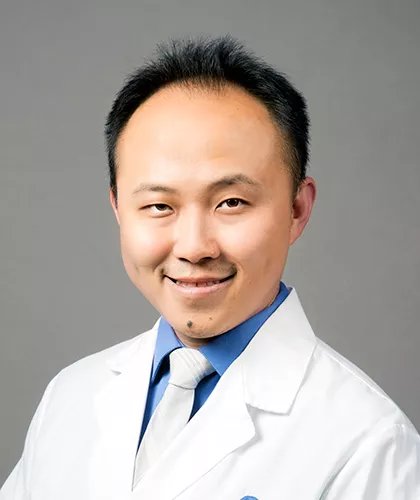
Eav Lim, DO, FACOOG
How patients benefit from the trial: Even with preoperative imaging, surgeons can miss small areas of disease during debulking surgery. Gleolan is an intraoperative tool that may help surgeons detect additional tumor tissue after the main surgery is complete.
The standard workflow doesn't change, but at the end of surgery, the team uses blue light to identify remaining tumor tissue. “We can react in real time to resect areas that are positive under blue light,” Dr. Lim says. “Those could be tumors that we otherwise might have missed.”
Who can participate in OVA-302:
- Patients with newly diagnosed or recurrent epithelial ovarian cancer
- Patients planning debulking surgery
- Patients who meet imaging and organ function criteria
Support for study participants
WellSpan Health offers more than 130 open clinical trials, making research accessible in our community and allowing research participants to stay with their local physicians. Research coordinators, clinical trial nurses and nurse navigators help with screening, paperwork, testing, follow-up and questions, creating a streamlined patient experience.
Physicians can call 717-741-8303 for the COSMIC and NRG-CC015 trials or
email elim@wellspan.org for the OVA-302 trial to refer a patient or learn more.